How Many Calories Burned Rowing Machine Calculator?
A rowing machine calorie calculator estimates your energy expenditure based on factors like your body weight, workout duration, and intensity. It uses a scientific formula to give you a personalized estimate.
You can generally burn between 400 to over 800 calories per hour on a rowing machine, depending heavily on how much you weigh and the effort you put in during your session.
Before you dive deep, here’s a quick overview of what you’ll find:
- Rowing machine calorie calculators offer a helpful starting point for tracking your workout effectiveness.
- Your body weight, workout duration, and intensity are the main factors influencing calorie burn.
- While useful, calculators provide estimates, not exact figures, as individual metabolism varies.
- You can significantly boost your calorie burn with proper form and high-intensity interval training (HIIT).
- Beyond calories, rowing offers incredible full-body fitness benefits.
How Many Calories Burned Rowing Machine Calculator?
A rowing machine calorie calculator uses your personal data and workout details to provide an estimate of your calorie expenditure. It’s a handy tool for tracking your fitness progress.
This tool helps you understand the energy cost of your workout, letting you adjust your efforts as needed.
Why Calorie Counting Matters for Your Goals
Tracking calories can feel a bit like balancing a checkbook for your body. If you’re aiming for weight management, understanding how many calories you burn is quite important.
Knowing your calorie expenditure helps you match your diet to your activity levels. It gives you a clear picture of your progress towards your fitness aspirations.
What Affects Calorie Burn on a Rower?
You might wonder why two people rowing for the same time burn different calories. Several factors play a role in this calorie equation.
It’s not just about the machine itself, but also how you use it and your own unique physiology.
Your Body Weight
Your body weight is one of the biggest determinants of calorie burn. Heavier individuals typically burn more calories during the same activity.
This is because moving a larger mass requires more energy from your body, even at similar intensity levels.
Workout Intensity and Duration
Are you taking a leisurely paddle or pushing yourself hard? The intensity of your workout directly correlates with calories burned. Higher intensity means more calories.
Similarly, the longer you row, the more energy you expend. A 30-minute hard session will burn more than a 10-minute easy one.
Your Fitness Level
Believe it or not, your fitness level also plays a part. A highly fit individual might be more efficient, potentially burning slightly fewer calories at the same perceived effort.
However, fit individuals can often sustain higher intensities for longer. This usually leads to a greater overall burn.
Rowing Machine Type
While less impactful than the other factors, the type of rowing machine can have a minor effect. Some machines, like air or water rowers, provide a more natural resistance curve.
This might encourage you to row harder, which in turn could lead to a higher calorie output.
Understanding the Rowing Machine Calorie Calculator
Most calculators rely on a standard scientific formula to estimate your calorie burn. It’s like a puzzle with several pieces coming together.
They take your personal information and apply a Metabolic Equivalent of Task (METs) value for rowing.
The METs Formula Explained
METs are a way to express the energy cost of physical activities. One MET is the energy you burn simply sitting quietly.
Rowing, depending on intensity, has a MET value ranging from about 4.8 (moderate) to 12 (very vigorous) (Compendium of Physical Activities, NIH).
The formula generally looks like this: METs x (Weight in kg) x Duration in hours = Calories Burned. It’s a helpful guide for comparison.
Where to Find a Reliable Calculator
Many fitness websites and even some rowing machine manufacturers offer their own calorie calculators. We found that most reputable sources use similar underlying formulas.
Look for calculators that ask for your weight, the duration of your workout, and your perceived intensity. These provide the most accurate estimations.
Here’s a quick glance at estimated calorie burn for a 30-minute rowing session:
| Body Weight | Moderate Pace (MET 6.0) | Vigorous Pace (MET 8.5) |
|---|---|---|
| 150 lbs (68 kg) | 204 calories | 289 calories |
| 180 lbs (82 kg) | 246 calories | 348 calories |
| 200 lbs (91 kg) | 276 calories | 391 calories |
*Estimates are approximate and can vary based on individual metabolism and specific workout variables.
Is the Calculator Always Accurate?
While calculators are great tools, they provide estimations rather than perfectly precise figures. Think of them as a useful approximation, not a definitive tally.
Your unique metabolism and specific rowing technique can introduce slight variations that a general calculator can’t fully capture.
What Calculators Miss
Calculators often miss out on individual physiological differences. Your basal metabolic rate (BMR), muscle mass, and even how efficiently your body uses oxygen all play a role.
Two people with the same weight and intensity might still burn slightly different amounts due to these internal factors.
The “Afterburn” Effect (EPOC)
Here’s a cool bonus: your body keeps burning calories even after your workout ends. This is known as the “afterburn effect,” or Excess Post-exercise Oxygen Consumption (EPOC).
High-intensity workouts, like interval training on a rower, can significantly boost EPOC, leading to additional calorie expenditure hours later.
Maximize Your Calorie Burn
Want to get the most bang for your buck on the rowing machine? There are smart strategies you can use to significantly increase your calorie output.
It often comes down to pushing your body a bit harder and working smarter, not just longer.
Interval Training for Greater Results
High-intensity interval training (HIIT) is your secret weapon. Short bursts of maximal effort followed by brief recovery periods can elevate your heart rate and calorie burn.
Many experts say HIIT is highly effective for both calorie expenditure and improving cardiovascular fitness (American College of Sports Medicine).
Focus on Proper Form
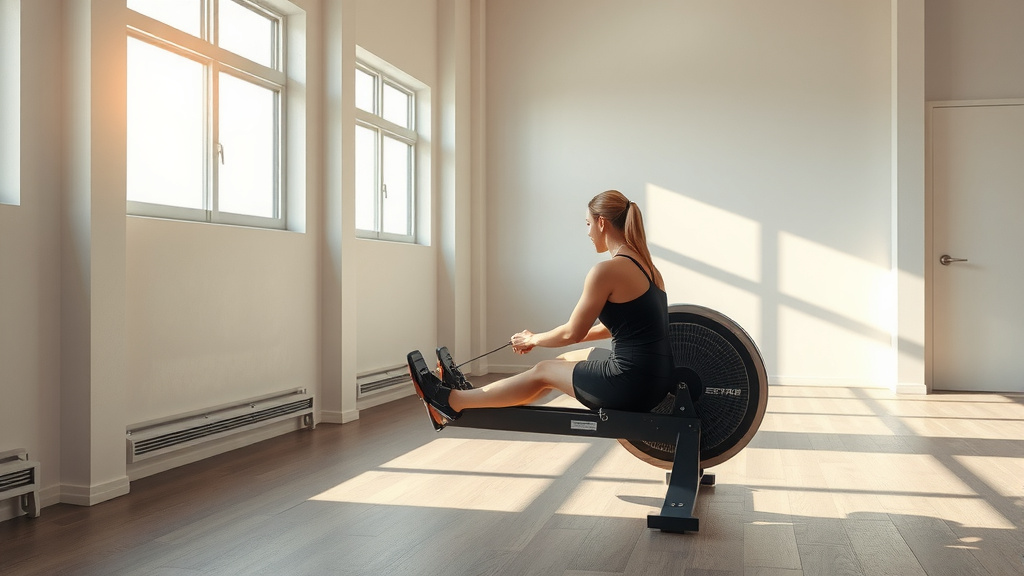
Good form isn’t just for avoiding injury; it’s also about efficiency and calorie burn. Engaging your full body correctly means more muscles are working harder.
Here’s a quick checklist for great rowing form:
- Catch: Shins vertical, arms straight, shoulders relaxed.
- Drive: Push with your legs first, then swing your back, then pull with your arms.
- Finish: Lean back slightly, handles to your sternum, legs fully extended.
- Recovery: Arms extend, body swings forward, then bend knees.
- Repeat: Maintain a smooth, continuous motion.
Consistency is Your Best Friend
No matter how intense your workout, consistency wins over time. Regular rowing sessions, even moderate ones, accumulate calorie burn and fitness gains.
Think of it like saving money; small, regular deposits add up to a big total.
Beyond calorie burn, rowing offers a treasure trove of benefits:
- It’s a full-body workout, engaging about 86% of your muscles.
- It’s low-impact, making it gentle on your joints.
- It builds both strength and cardiovascular endurance.
- It can reduce stress and improve mental well-being.
- It’s a fantastic way to boost stamina and energy levels.
Real-World Expectations
It’s important to set realistic expectations for calorie burn and fitness goals. While a calculator offers guidance, remember it’s part of a bigger picture.
Combine your rowing efforts with a balanced diet and other forms of activity for the best overall results.
Conclusion
A rowing machine calorie calculator is a fantastic tool to estimate your workout’s energy expenditure and help you stay on track with your fitness goals. While not 100% precise, it provides valuable insights based on your weight, intensity, and duration.
Remember that factors like individual metabolism and the afterburn effect also play a role. By focusing on proper form, incorporating interval training, and maintaining consistency, you can maximize your calorie burn and unlock the full-body benefits a rowing machine offers. Keep pulling, you’re doing great!
What’s the average calorie burn for a 30-minute rowing session?
For a 30-minute rowing session, you can expect to burn anywhere from 200 to 400+ calories. This range depends largely on your body weight and the intensity of your rowing. A lighter person rowing moderately will burn fewer calories than a heavier person rowing vigorously.
Do smart rowing machines calculate calories more accurately?
Smart rowing machines often provide more accurate calorie estimates than generic online calculators because they can track your power output (watts) and stroke rate in real-time. This direct measurement of your effort allows for a more personalized calculation, though it’s still an estimate.
Can rowing help me lose weight?
Yes, rowing can absolutely help you lose weight! It’s an excellent full-body cardio workout that burns a significant number of calories. When combined with a healthy, calorie-controlled diet, consistent rowing can create the calorie deficit needed for effective weight loss.
Is rowing better for calorie burn than running?
Comparing rowing and running for calorie burn depends on intensity and individual factors. Both are highly effective. Rowing offers a full-body workout that can sometimes burn more calories than running for the same perceived effort, especially because it engages more muscle groups.
How often should I use a rowing machine to see results?
To see noticeable results, aim to use your rowing machine 3-5 times per week for at least 20-45 minutes per session. Consistency is key. You might start with shorter durations and gradually increase as your fitness improves. Listening to your body is always important.