Can You Build Muscle with a Rowing Machine?

Yes, you absolutely can build muscle with a rowing machine, especially if you focus on proper technique and resistance. Rowing is a fantastic full-body workout that engages many major muscle groups, making it effective for strength and conditioning.
You might be surprised by how many muscles rowing activates. It works your legs, core, back, and arms, offering a surprisingly comprehensive strength session. When done correctly, rowing can add significant muscle definition and improve overall strength.
TL;DR:
- Rowing machines can build muscle.
- Targets legs, core, back, and arms.
- Proper technique is key for muscle growth.
- Can be a full-body strength workout.
Ready to discover how rowing can change your physique? Let’s dive into exactly how you can maximize muscle gain with your rowing machine.
Unlocking Muscle Growth with Your Rowing Machine
Yes, you can absolutely build muscle with a rowing machine. It’s not just for cardio! Rowing provides a full-body workout that engages many major muscle groups, making it excellent for strength and conditioning.
You might be surprised by how many muscles are working hard during a single rowing stroke. We’re talking about your legs, core, back, and arms. This makes rowing a surprisingly effective way to build strength and definition.
Understanding the Rowing Stroke for Muscle Activation
To really understand how rowing builds muscle, let’s break down the stroke itself. It’s a complex movement, but we can divide it into four main phases. Each phase targets different muscle groups.
Think of it as a coordinated dance between your upper and lower body. Getting this timing right is crucial for maximizing muscle engagement.
The Catch Phase
This is where you start. Your knees are bent, and you’re close to the front of the machine. Your shins should be vertical. Here, your hamstrings and glutes are primed to generate power.
Your core is engaged, keeping you stable. Your arms are extended, holding the handle loosely. It’s about setting up for the drive.
The Drive Phase (Powerhouse of Muscle Building)
This is where the magic happens for muscle growth! You push off with your legs first. Your quadriceps, hamstrings, and glutes do most of the work here. It’s like a powerful leap.
As your legs extend, your core muscles (like your abs and obliques) stabilize your torso. Then, your back muscles (your lats, rhomboids, and traps) kick in, pulling the handle towards your body. Finally, your biceps join the party for the last bit of the pull.
This phase is where you generate nearly 60% of the movement’s power (Journal of Sports Sciences).
The Finish Phase
You’re at the end of the stroke. Your legs are straight, you’re leaning back slightly, and the handle is at your lower ribs. Your core muscles are still active, keeping your posture strong.
Your upper back and bicep muscles are fully contracted. This phase allows you to squeeze those muscles one last time before recovering.
The Recovery Phase
Now, you reverse the drive. Your arms extend first, then your body swings forward, and finally, your knees bend. This phase is less about muscle building and more about control.
It’s important for preparing for the next powerful stroke. Your core muscles still play a role in maintaining balance and fluidity.
Which Muscles Work Hardest on a Rowing Machine?
Rowing is often called a full-body workout because it truly engages a huge number of muscles. From your calves to your shoulders, most major muscle groups are involved.
Let’s look at the specific muscle groups that get the most attention during a rowing session. You’ll see why it’s so effective for building overall strength.
Lower Body Muscles
Your legs are the primary power source in rowing. They initiate the drive and generate significant force. This is great news if you want stronger, more defined legs.
- Quadriceps: These are the large muscles on the front of your thighs. They extend your knees as you push back.
- Hamstrings: Located at the back of your thighs, they help extend your hips and bend your knees as you recover.
- Glutes: Your gluteal muscles (the “butt” muscles) are central to hip extension, pushing you powerfully away from the foot stretcher.
- Calves: While not the main movers, your calf muscles (gastrocnemius and soleus) contribute to the push-off and stability.
Core Muscles
Your core is the unsung hero of rowing. It connects your upper and lower body, transferring power and preventing injury. A strong core means a more powerful stroke.
- Rectus Abdominis: Your “six-pack” muscles work to stabilize your torso and keep you upright.
- Obliques: These side abdominal muscles help with rotational stability and prevent twisting.
- Erector Spinae: These muscles along your spine help maintain a strong, upright posture throughout the stroke.
We found that a strong core is essential for efficient power transfer from your legs to your upper body (American Council on Exercise).
Upper Body Muscles
Don’t forget your upper body! While your legs initiate the power, your back and arms finish the stroke. This makes rowing excellent for upper body strength too.
- Latissimus Dorsi (Lats): These are the large muscles in your middle and lower back. They pull the handle towards your body.
- Trapezius (Traps) and Rhomboids: Located in your upper back, they help retract your shoulder blades and maintain good posture.
- Biceps: These muscles on the front of your upper arm flex your elbows, bringing the handle to your body.
- Deltoids: Your shoulder muscles (especially the rear deltoids) assist in pulling the handle back.
It’s truly a symphony of muscles working together!
How to Maximize Muscle Gain with Your Rowing Machine
So, you want to build muscle with your rower? Great! It’s not just about getting on and pulling. There are specific strategies you can use to optimize for muscle growth.
Think about how you’d lift weights: You focus on resistance and controlled movements. The same principles apply here.
Focus on Proper Technique
This is arguably the most important factor. Incorrect form can lead to injury and less effective muscle engagement. It’s like trying to bench press with bad form – you won’t get the same results.
Remember the leg-drive, then body swing, then arm pull sequence. Don’t rush it, and always lead with your legs.
- Keep your core engaged throughout.
- Maintain a strong, straight back.
- Drive primarily with your legs.
- Control the recovery phase, don’t just flop forward.
Adjust Resistance for Strength Building
Rowing machines usually have a damper setting (for air resistance rowers) or a magnetic resistance setting. For muscle building, you’ll want to increase this resistance.
Higher resistance simulates lifting heavier weights. It puts more strain on your muscles, prompting them to grow stronger. Don’t go too high too fast, though; prioritize good form.
Many experts suggest using a damper setting between 5-7 for a good mix of power and control.
Incorporate Strength-Focused Workouts
Vary your workouts to challenge your muscles in different ways. Don’t just do long, steady-state rows. Try different intervals and power strokes.
Here are a few ideas:
High Resistance, Low Stroke Rate
Set a higher damper/resistance. Focus on powerful, deliberate strokes rather than speed. Aim for a stroke rate of 18-22 strokes per minute (SPM).
This is akin to doing heavy reps in the gym. You’re trying to move a lot of “weight” with each pull.
Power Intervals
Alternate short bursts of maximum effort rowing with periods of active rest. For example, row at maximum effort for 1 minute, then active rest for 2 minutes. Repeat several times.
This helps build explosive power and muscle endurance. It’s a great way to push your limits.
Pyramid Workouts
Start with a medium resistance and a moderate stroke rate. Gradually increase the resistance while slightly decreasing your stroke rate for a few intervals. Then, reverse the pyramid back down.
This challenges your muscles progressively and then allows for a controlled cool-down. It keeps your body guessing.
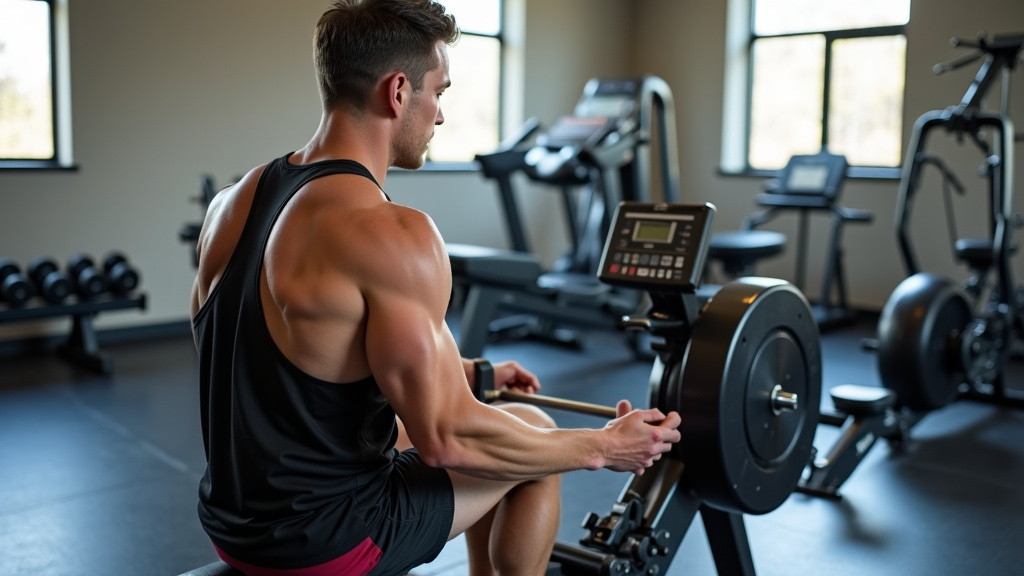
Comparing Rowing to Other Muscle-Building Activities
How does rowing stack up against traditional weightlifting or other bodyweight exercises? It’s important to have realistic expectations.
Rowing won’t turn you into a bodybuilder overnight. However, it’s an excellent tool for functional strength, muscle endurance, and overall muscle definition.
Rowing vs. Weightlifting
Weightlifting usually allows for heavier, more isolated movements targeting individual muscles or small muscle groups. This is often more effective for maximizing muscle hypertrophy (muscle growth in size).
Rowing, on the other hand, excels at building full-body, interconnected strength. It’s more about integrated muscle function.
| Feature | Rowing Machine | Weightlifting |
|---|---|---|
| Muscle Engagement | Full-body, compound | Isolated & compound |
| Primary Goal | Cardio, endurance, functional strength | Hypertrophy, maximal strength |
| Risk of Injury | Low (with good form) | Moderate to high (with poor form/heavy weight) |
| Impact on Joints | Low impact | Moderate to high impact |
| Equipment Needed | One machine | Various weights, racks, etc. |
You can use rowing to complement your weightlifting routine or as a primary strength-building tool if you prefer low-impact exercises.
The Role of Nutrition and Recovery
Remember, muscle growth doesn’t happen in the gym alone. What you do outside of your workouts is just as important.
If your goal is to build muscle, you need to fuel your body correctly. This means eating enough protein, carbohydrates, and healthy fats.
Also, don’t skip rest! Your muscles grow and repair themselves during recovery periods. Aim for 7-9 hours of sleep per night.
Many guidelines point to adequate protein intake (1.6-2.2 grams per kilogram of body weight) as a good target for muscle growth (Journal of Sports Science & Medicine).
How Long Until You See Muscle Gains from Rowing?
This is a common question, and the answer can vary. Like any fitness journey, consistency is key. You won’t see results overnight, but you will see them if you stick with it.
Generally, with a consistent routine (3-5 times a week), proper technique, and adequate resistance, you might start noticing changes in muscle tone and strength within 4-8 weeks.
Significant muscle mass gains might take longer, perhaps 3-6 months or more. It depends on your starting fitness level, genetics, and diet.
Stay patient and celebrate the small victories along the way. Every stroke counts towards a stronger you!
Final Checklist for Optimal Muscle Gains with Rowing
Ready to make your rowing machine a muscle-building powerhouse? Here’s a quick checklist to help you stay on track:
- Commit to consistent training (3-5 times per week).
- Master the proper rowing technique first.
- Increase resistance to challenge your muscles.
- Incorporate varying workout types (intervals, power strokes).
- Eat enough protein and maintain a balanced diet.
- Prioritize sleep and allow for proper muscle recovery.
By following these steps, you’ll be well on your way to building noticeable strength and definition with your rowing machine. You’ve got this!