How to Choose a Weight Bench with Storage
The best weight bench with storage gives you easy access to the weights you use most without shrinking your safe workout area. Compare storage type, bench footprint, clearance, load organization and how quickly you can change exercises.
On this page (9 sections)
- What type of storage does a weight bench need?
- How much space should you leave around a bench?
- Should you use adjustable or fixed dumbbells?
- When is a separate dumbbell rack better?
- Is a compact dumbbell set enough for a bench setup?
- How do you match storage to the room?
- How should you organize weights beside a bench?
- Can a weight bench with storage replace a full gym setup?
- What is the best way to choose a weight bench with storage?
A weight bench with storage should keep your training weights close while leaving enough open floor for lifting, stepping, and changing positions. The right setup depends on the weight type, the storage location, and the room you have around the bench.
If bench height is part of the fit, see our guide to adjustable-height flat benches.
Storage can mean built-in shelves under the bench, a separate dumbbell rack beside it, or a compact dumbbell set that takes less room than many fixed pairs. Start with the weights you plan to use, then choose the bench and storage arrangement around them.
If you prefer a flat bench that folds for storage, see folding flat weight benches.
For a broader overview of bench styles, read our guide to which weight bench to buy. If you need to save floor space, compare the best folding weight bench options before choosing a fixed frame.
What type of storage does a weight bench need?
The best storage type depends on what you lift and how often you change weights. Integrated storage keeps equipment in one footprint, while a separate rack usually offers easier sorting and more capacity.
Check these points before you buy:
- Storage position: Under-bench storage can keep weights out of the main walking path, but it may be harder to reach during floor exercises.
- Weight shape: Fixed dumbbells, adjustable dumbbells, plates, and kettlebells need different support areas.
- Access height: Storage should let you lift weights out without striking the bench frame or twisting around it.
- Clearance: Leave enough room to sit, lie down, stand, and move the weights into position.
- Future changes: A storage area that fits today may become limiting if your training weights grow.
A bench with built-in storage can look tidy, but tidy does not always mean convenient. Think about where your hands will go when you are tired and trying to finish a set.
Place the weights you use most often where you can reach them without crossing the bench or stepping into your lifting path. If you must stretch or reach behind the frame, that spot will soon become a chore.
Consider how you set weights down as well as how you pick them up. A shelf that is too low or too narrow can make even a short set down awkward.
Picture a normal session from start to finish, including warm ups and putting everything away. The storage that works well in that full sequence is usually the better choice for daily use.
Match the storage to your habits rather than to a photo of a tidy room. A simple setup you use every time will serve you better than a clever design you must work around.
How much space should you leave around a bench?
Leave a clear workout zone around the bench, not just enough room for the frame. **The bench, stored weights, and your body position all need to fit without forcing you into a wall or nearby furniture.
For smaller rooms, compare compact weight benches.**
Measure the bench at its widest and longest points. Then mark the area needed for:
- Lying flat and sitting upright
- Carrying dumbbells to the bench
- Standing for presses, curls, or lunges
- Adjusting the back pad
- Removing weights from storage
- Moving safely around the equipment
A folding bench may reduce storage space when not in use, but the open workout position still needs a usable floor area. Our guide to best foldable weight bench under bed storage can help if the bench must disappear between sessions.
Wall-mounted storage can free floor space, but it changes the installation requirements. See how to choose a folding wall mount weight bench if your room has limited floor area and a suitable wall.
Should you use adjustable or fixed dumbbells?
Choose adjustable dumbbells when you want several training loads in a compact area. Choose fixed dumbbells when fast access and simple weight changes matter more than reducing the number of pieces.
The PowerBlock Elite EXP 90 Adjustable Dumbbells measure 12 in L x 7 in W x 7 in H and provide 16 weight increments. Their magnetic polypropylene pin selects the weight, while 2.5 lb micro weights allow smaller changes between loads.
This type of dumbbell can work well beside a bench because one pair covers a broad range from beginner progression to heavier home strength work. The trade-off is that you need a nearby place to set the pair down between exercises, and the compact shape is different from a traditional dumbbell.
The set includes 2 dumbbells and uses powder-coat painted steel with polypropylene and steel handle materials. Stage 2 and Stage 3 expansion kits can increase the weight to 70 lb or 90 lb per hand, but those kits are sold separately and are not compatible with Elite USA 90 expansions or accessories.
When is a separate dumbbell rack better?
A separate rack is better when you use several fixed dumbbell pairs and want each pair visible and reachable. It takes more floor space than a compact adjustable set, but organized tiers can make weight changes faster.
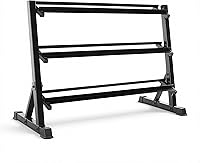
The CAP 2-Tier & 3-Tier Dumbbell Rack for Home Gym has 3 shelves in the described 3-tier version. Its dimensions are 51.57 in L x 25.6 in W x 37.4 in H, so measure the rack footprint beside the bench rather than assuming it will fit in a narrow gap.
The lower 2 shelves are angled, which can help you load and unload dumbbells from different heights. The rack accommodates multiple dumbbell sizes, including the 5–35 lb, 5–50 lb, and 5–75 lb pair ranges named in its title.
Assembly affects stability. Keep the bolts loose until the rack is fully assembled, then place it on a flat, level surface before tightening the hardware.
This rack suits a dedicated home gym with several fixed pairs. It may be too large for a bedroom or multipurpose room where the bench must fold away after each workout.
Is a compact dumbbell set enough for a bench setup?
A compact dumbbell set can be enough when your workouts use a small range of lighter weights and you want storage included in the same purchase. It is less suitable if you need many heavier increments for progressive strength work.
The JFIT Dumbbell Pairs or Sets include 7 pieces: 3 lb, 5 lb, and 8 lb dumbbell pairs plus the rack. The neoprene coating provides a non-slip grip, while the hex-shaped ends help prevent rolling between sets.
This is a fixed weight set, so there is no pin to adjust and no dial to set. You simply pick up the pair you need, which can make quick changes between exercises feel straightforward.
The stand rack keeps the three pairs together and can suit a bench placed in a small workout corner. It gives each pair a set place, so the weights do not have to sit loose on the floor beside the bench.
The set is aimed at lighter work. It suits people who train with 3 lb, 5 lb, and 8 lb weights and do not need a wider range.
Arm work, shoulder work, and light strength sessions may sit comfortably in this range, while heavier presses or rows may soon feel too light.
The neoprene coating can feel comfortable in the hand during repeated use. It also helps protect hands and floors during home or studio sessions.
The hex-shaped ends help stop the dumbbells from rolling away between sets, which matters when you put them down on a hard floor beside the bench.
The cast-iron core gives the set its weight and a solid feel. Neoprene on the outside does not change that core, so the dumbbells still have the heft you would expect from their stated weights.
Assembly is part of the setup to plan for. The rack is described as easy to assemble with a screwdriver, so set aside a short time to build it before your first workout.
Place the stand where you can see all three pairs without reaching over the bench. A spot at the side of the bench, or just beyond the end, often works better than a spot behind it.
You should be able to lift each pair off and set it back down without awkward twisting, especially when you are already tired.
The stand uses less floor space than a full tiered rack for many fixed pairs. That smaller footprint can help in a bedroom, office, or shared room where the bench also needs room to open and adjust.
Three weight levels may be plenty for aerobics, cardio exercise, and lighter strength work, but they may not keep pace as your strength grows. There is no expansion path listed for this set to add heavier pairs later.
Wipe the neoprene coating clean when needed and check that each pair is seated properly on the stand after use. Store the set together after every session so you can see at a glance what you have before you start.
For a bench in a small corner, this set can offer a neat and simple starting point. It works best when your training goals genuinely fit the three weights included.
How do you match storage to the room?
Match the storage to the room's main use and the path you need to keep clear. A permanent rack works in a dedicated gym, while a compact bench and dumbbell set make more sense in a bedroom, office, or shared living area.
Use this decision guide:
- Dedicated room with many fixed pairs: choose a separate tiered dumbbell rack.
- Small room with several weight levels: choose adjustable dumbbells.
- Light workouts with 3 weight levels: choose a compact dumbbell set with stand.
- Shared room that must stay tidy: choose a folding bench and compact storage.
- Furniture-focused room: choose a bench with discreet storage or a design-led frame.
Start with how the room is used for the rest of the week, not only during workouts. A rack that looks fine in an empty gym may block a door, a desk, or a walkway in a shared room.
Measure the bench, the storage, and the area you need to move in as one group. That combined footprint tells you more than any single product measurement on its own.
If the bench must fold away, check what remains visible and what still needs floor space during a session. Compact storage should leave the room usable between workouts as well as during them.
Choose the arrangement you will actually put back in place after each session. A setup that is easy to reset is more likely to stay organized over time.
| Your setup | Storage choice |
|---|---|
| Dedicated room with many fixed pairs | Separate tiered dumbbell rack |
| Small room with several weight levels | Adjustable dumbbells |
| Light workouts with 3 weight levels | Compact dumbbell set with stand |
| Shared room that must stay tidy | Folding bench and compact storage |
| Furniture-focused room | Bench with discreet storage or a design-led frame |
A storage bench can also affect the room's appearance. If the equipment stays visible, read how to choose a weight bench that looks like furniture for ideas about fitting the bench into a shared space.
How should you organize weights beside a bench?
Organize weights by frequency of use, size, and the order of your workout. Keep the first weights you need closest to the bench, and place heavier or less-used equipment where it cannot interfere with movement.
Put paired dumbbells together instead of scattering them around the room. Return each pair to the same location after a session so you can see what is available before starting.
Keep storage outside the bench's main entry and exit area. A rack placed directly behind your feet or beside the back pad can make a small room feel crowded even if the measurements technically fit.
Inspect the floor before placing a rack or bench. A flat surface helps the equipment sit more evenly, and a clear floor reduces the chance of catching a foot on loose weights.
Plan your layout around the first exercise in your routine. The weights for that movement should be the easiest to reach, since you will be fresh and still setting up your space.
Place the next weights in the order you expect to use them, which creates a simple flow without repeated trips across the room.
Heavier pairs often benefit from a lower or more stable position. They should still be reachable, but they do not need to sit in the middle of your main walking path.
Keep pairs together so you do not start a set with mismatched weights. A clear home for each pair also makes it easier to notice if something is missing.
Use the full width of a rack rather than stacking pairs in one section. Spreading weights out keeps the storage readable and helps you find the right pair quickly.
Leave a gap between storage and the bench frame. That gap gives you room to sit, stand, and adjust the back pad without squeezing past a rack.
Think about where you will set a pair down mid-set. A safe landing spot near the bench is more useful than storage that is tidy but far away.
Avoid placing storage where you need to step over weights to reach the bench.
For a compact set with a stand, keep the stand in one fixed spot. Moving it around each session can make it harder to build a routine that feels automatic.
For adjustable dumbbells, keep the pair in one place between exercises. Changing weight in one spot is simpler than carrying the dumbbells to different areas of the room.
After each session, reset the weights in the same order again. A quick reset at the end saves time and keeps the next workout ready to start.
Check the floor and the storage area from time to time. Tighten anything that has loosened, clear away items that do not belong, and keep the workout zone open for the next session.
Can a weight bench with storage replace a full gym setup?
A weight bench with storage can support many home workouts, but it does not replace every type of equipment or training space. Your choice should match the exercises you actually plan to do.
Dumbbells and a bench can support presses, rows, curls, lunges, and other strength exercises. If you want a combined setup, compare weight bench and barbell sets.
A compact set may be enough for lighter sessions, while adjustable dumbbells or a larger rack provide more room to progress.
If you also want conditioning equipment, plan its footprint separately. A rowing machine guide can help you compare another large piece of home fitness equipment, while our guide to the best rowing machine for weight loss focuses on a different training goal.
Do not place a bench so close to a rower, treadmill, or bike that one piece blocks access to another. Draw each equipment footprint on the floor and include the movement space needed to use it.
What is the best way to choose a weight bench with storage?
Choose the storage system first, then confirm that the bench leaves enough room for safe movement. Pick adjustable dumbbells for broad weight progression in a small footprint, a tiered rack for several fixed pairs, or the JFIT set for lighter weights with a compact stand.
The PowerBlock pair suits a broad range of exercises and replaces 16 traditional dumbbell pairs. It adjusts from 5 lb to 50 lb per hand, which can cover early progression and heavier strength work in one compact set.
The CAP rack suits a dedicated room with multiple fixed dumbbell pairs and a larger available footprint. Its tiered design is built for organized storage, but it needs a room where the rack can stay in place.
The JFIT set suits lighter home, studio, aerobics, and cardio sessions where 3 lb, 5 lb, and 8 lb pairs are enough. The included stand helps keep those pairs together without the footprint of a full rack.
Start by listing the exercises you plan to do most often. That list will show whether you need quick access to a few light pairs, a wider range of weights, or space for many fixed pairs.
Next, measure the room with the bench in its open position. Include the storage, the space to sit and lie down, and the area you need to stand and change weights.
Do not rely on the folded or stored size alone, since the workout happens when the bench is open and the weights are out.
Consider how the room is used between sessions. A permanent setup may suit a dedicated gym, while a shared room may need storage that keeps the space tidy and easy to reset.
Think about progression as well as day one. Adjustable dumbbells can offer more weight levels in a small footprint, while a rack can hold more fixed pairs as a collection grows.
Measure the open bench, storage, and walking area together before ordering. Our guide to home gym weight benches compares options for different setups.
Then choose the smallest storage arrangement that keeps your weights accessible without taking over the workout space. The best fit is the one you can reach, use, and put away without fuss every session.
Frequently asked questions
What should I look for in a weight bench with storage?
Look for storage that keeps your weights reachable without blocking the bench, enough clearance for every exercise, and a footprint that fits the room. Decide whether you need integrated bench storage, a separate rack, or a compact dumbbell set before choosing the bench.
Is a weight bench with weight storage good for a small room?
A weight bench with weight storage can suit a small room if the stored weights stay inside the bench footprint and you still have clear space for setup and movement. Measure the bench, storage area, and workout zone together rather than checking the folded size alone.
Are adjustable dumbbells useful with a storage bench?
Adjustable dumbbells can reduce the number of separate weights you need to store beside a bench. PowerBlock Elite EXP 90 Adjustable Dumbbells replace 16 traditional dumbbell pairs and adjust from 5 lb to 50 lb per hand, which can help in a compact setup.
Should dumbbells be stored on a bench or rack?
Store dumbbells on the bench only when its storage area is designed for their size and weight. A separate rack can provide more organized access, while a compact set with its own stand may suit lighter workouts and limited floor space.