What Weight Dumbbells Should You Use?
Choose a dumbbell you can lift with steady form for your target repetitions, with the final 2 or 3 reps feeling challenging but controlled. Start lighter for isolation exercises and overhead work, then use more weight for legs, rows, and larger muscle groups.
On this page (9 sections)
- What weight dumbbells should you use for each exercise?
- How can beginners choose a dumbbell weight?
- Should you buy fixed or adjustable dumbbells?
- When should you choose a heavier dumbbell set?
- How do you know if your dumbbell weight is too heavy?
- How do you know if your dumbbell weight is too light?
- How should you progress to a heavier dumbbell?
- Can dumbbells help with weight-loss workouts?
- What is the best dumbbell weight for you?
The right dumbbell weight is the heaviest load you can control through your planned repetitions without swinging, shortening the movement, or losing posture.
That simple rule works across almost every exercise. It also helps you separate a useful challenge from a load that is too much for today.
Start lighter for small-muscle and overhead exercises. Shoulder raises, curls, and triceps work give you less room to hide poor control.
Then use heavier resistance for rows, presses, squats, and lunges. Those movements spread the work across larger muscles and usually allow more load.
Your goal is not to find one perfect number. You need a weight that matches the exercise, your experience, and the number of repetitions you want to complete.
A weight that suits a row may be far too heavy for a lateral raise. Treating every exercise the same can ruin form on the lighter movements.
Experience matters as well. A new lifter may need a lighter starting point while balance and timing improve.
Repetition goals change the choice too. Higher repetitions usually call for less resistance than heavier, lower-repetition sets.
Think of each exercise as its own test. Choose the load for the movement you are about to perform, not the load you used last.
Grip, balance, and range of motion can also limit the load. A lunge may feel harder because of balance, not because your legs are weak.
When in doubt, begin with the lighter option. You can always move up after the first set feels steady and controlled.
The right starting weight should leave the final repetitions demanding. Your form should still look the same as it did at the start.
What weight dumbbells should you use for each exercise?
Use lighter dumbbells for isolation and overhead movements, and heavier dumbbells for exercises that use several large muscle groups. Your grip, balance, range of motion, and technique also affect the weight you can safely control.
| Exercise | Start with | Why |
|---|---|---|
| Lateral raise | Light weight | The shoulder muscles work through a long lever |
| Biceps curl | Light to moderate | The movement isolates the arms |
| Triceps extension | Light to moderate | Overhead control can limit the load |
| Shoulder press | Light to moderate | The weight travels overhead |
| Chest press | Moderate | The chest and arms work together |
| One-arm row | Moderate to heavy | The back uses larger muscle groups |
| Goblet squat | Moderate to heavy | The legs can usually handle more resistance |
| Romanian deadlift | Moderate to heavy | The hips and legs share the work |
| Walking lunge | Moderate | Balance may limit the load before leg strength does |
These are starting categories, not fixed rules. Your own strength, balance, and technique will decide where you actually begin.
A category that looks moderate on paper may feel heavy overhead. Conversely, a row may allow more resistance than you first expect.
If your form changes before the target repetitions are complete, lower the weight even if the number feels small.
Watch for swinging, leaning, shrugging, or cutting the movement short. Those signs matter more than the number printed on the dumbbell.
It can help to test a movement with a lighter pair first. One controlled set often tells you more than guessing from the table.
Different exercises also fail for different reasons. Balance may limit a lunge while grip limits a row, and overhead control may limit a press.
If you are also choosing a stable platform for presses or rows, compare our guide to which weight bench to buy.
A bench changes how you set up and how much stabiliser muscle work you need. That setup can influence the weight you can safely control.
Choose your bench and your dumbbell weight together. A steady platform makes it easier to judge whether the load or the setup is the problem.
How can beginners choose a dumbbell weight?
Beginners should choose a weight that allows 8 to 12 smooth repetitions, with the last 2 or 3 reps requiring effort but not momentum. Test the movement with a lighter load before deciding whether to move up.
Use this simple process:
- Pick a light starting weight.
- Perform 8 controlled repetitions.
- Check your posture, grip, breathing, and range of motion.
- Continue toward 12 repetitions if your form remains steady.
- Increase slightly only when the set feels too easy.
Stop the set if you need to swing, lean, shrug, or shorten the movement. Those changes often mean the weight is too heavy for the exercise, even if you can force out more repetitions.
For a broader buying decision, read what dumbbell set to buy before choosing between fixed and adjustable weights.
What dumbbell weight should you use for upper-body exercises?
For upper-body exercises, use a load that lets you keep your shoulders, wrists, and elbows in the intended position. Curls, raises, and triceps exercises usually need less weight than rows and presses.
You can use different weights on the same training day. For example, a lateral raise may require a light pair, while a one-arm row may require a much heavier dumbbell.
Women should follow the same exercise-based method rather than choosing a weight from a gender label. If you are also choosing a bench, see weight benches for women.
Our guide to what weight dumbbells for women explains how to select resistance by movement and experience.
What dumbbell weight should you use for lower-body exercises?
Lower-body exercises often allow more resistance because the legs and hips use larger muscle groups. Choose a weight that keeps your knees, hips, and back in a stable position, especially during squats, lunges, and deadlifts.
A goblet squat may use one dumbbell held at the chest. Lunges may use one dumbbell in each hand, but balance can become the limiting factor before your legs reach their strength limit.
Increase slowly when the movement feels stable. More weight is not helpful if it makes you shorten the range or lose control near the bottom of the exercise.
Should you buy fixed or adjustable dumbbells?
Adjustable dumbbells suit you if you need several weight levels in a small space. If handle fit matters too, compare adjustable dumbbells for small hands.
Fixed dumbbells are easier to pick up quickly, while adjustable sets can cover more exercises with fewer pieces. For the trade-offs, compare fixed and adjustable dumbbells.
The PowerBlock Elite EXP 90 is a set of 2 adjustable dumbbells. Its magnetic polypropylene pin selects the weight, and the set includes 2.5 lb micro weights for smaller increases.
The pair measures 12 in long by 7 in wide by 7 in high and replaces 16 traditional dumbbell pairs. Stage 2 and Stage 3 expansion kits can raise the weight to 70 lb or 90 lb per hand, sold separately.
Those expansions are not compatible with Elite USA 90 expansions or accessories.
Choose it if you expect your strength to develop and want many settings in a compact format. A fixed set may feel simpler if you want to move between exercises without changing settings.
The Amazon Basics Adjustable Dumbbell Hand Weight Set includes 2 dumbbell handles, 4 plates weighing 2.5 lb each, 4 plates weighing 5 lb each, and 4 collars weighing 0.5 lb each. The total set weight is 38 lb.
Threaded collars secure the plates, and the black storage case has a carry handle.
This set fits people who want adjustable resistance for arms, shoulders, back, and full-body training. Its included plates support changes between exercises, but changing plates takes more steps than selecting a setting on a selector-style adjustable dumbbell.
If you are deciding whether adjustable weights count as free weights, see are dumbbells free weights.
When should you choose a heavier dumbbell set?
Choose a heavier set when your main exercises include rows, presses, squats, lunges, and deadlifts, and your current weights no longer challenge you with controlled repetitions. You also need enough storage space and a safe way to keep the weights organized.
The CAP Rubber Coated Dumbbell Weight Set with Rack includes 5 pairs of rubber hex dumbbells and 1 vertical A-Frame rack. See more CAP Barbell dumbbell sets if you want to compare the brand's options.
The pairs are 5 lb, 10 lb, 15 lb, 20 lb, and 25 lb.
Rubber coating helps protect floors, reduce noise, and resist wear, while the hex shape helps prevent rolling. Knurled steel handles provide a textured grip.
The rack measures 12.8 in deep by 14.37 in wide by 25.98 in high. Its vertical design keeps the weights off the floor and within reach.
Choose this set if you want several fixed options ready for different exercises. It takes more floor space than one adjustable pair, but you do not need to change plates between sets.
For a larger fixed-weight setup, compare options in our guide to the best heavy weight dumbbell set.
How do you know if your dumbbell weight is too heavy?
Your dumbbell is too heavy when you cannot complete the movement with the same controlled technique from the first repetition to the last. Common signs include swinging, leaning, holding your breath, shrugging, bending your wrists, or using another body part to finish the lift.
Lower the weight and repeat the set with a slower, cleaner movement. You can also reduce repetitions while you learn a new exercise, then build back toward your normal range.
A heavy weight is not automatically better. The useful load is the one that challenges the target muscles while letting you complete the intended movement.
How do you know if your dumbbell weight is too light?
Your dumbbell may be too light when you complete the entire set with no meaningful effort and no change in speed or control.
The last few repetitions should feel different from the first few. If the pace stays easy throughout, the load is unlikely to drive progress.
Another sign is excess capacity. If you could keep repeating the exercise far beyond your planned range, increase the load by the smallest available step.
Small increases help you learn the new weight without losing form. A large jump can make the movement harder for reasons unrelated to strength.
Do not judge the weight only by muscle soreness. A controlled set can be useful without leaving you sore, and soreness does not prove that the load was appropriate.
Soreness often reflects novelty or volume more than a perfect load choice. It should not be the main signal you use each week.
Look instead at speed, control, and effort near the end of the set. The final repetitions should slow down slightly while your technique stays clean.
Record the exercise, weight, repetitions, and how steady the final repetitions felt. A simple log makes the pattern easy to see over time.
Note whether you finished with effort left in reserve. That detail helps you decide if the next session needs more repetitions or more weight.
This gives you a clearer progression plan than choosing a heavier dumbbell at random. You can add repetitions first, then add load when control remains strong.
Keep the notes brief and honest. Over several weeks, they will show which exercises need a change and which weights still suit you.
How should you progress to a heavier dumbbell?
Progress when you can complete your target repetitions with stable form across every planned set. First add repetitions within your range, then increase the weight and return to the lower end of that range.
For example, you might work from 8 to 12 repetitions at one weight. Once 12 feels controlled, move up slightly and begin again at 8.
If the next weight is much heavier, keep the new sets shorter until your control improves.
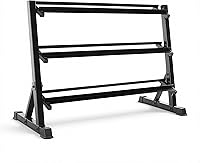
Store dumbbells where they cannot roll into walkways or overload a shelf. A vertical rack can help organize fixed weights, while an adjustable pair may be easier to keep in a small room.
For rack ideas, see best 3 tier dumbbell storage rack.
Can dumbbells help with weight-loss workouts?
Dumbbells can add resistance to full-body workouts, but weight loss depends on your overall activity and food intake.
The dumbbells themselves do not create the result. They help make training sessions more demanding when you use them consistently.
Rows, squats, lunges, presses, and carries can raise the physical demand of a session when performed with controlled form.
Compound movements use large muscle groups and often allow heavier loads. That can make a workout feel harder without needing long sessions.
Choose weights that let you complete each set with steady technique. Form should not fall apart as fatigue builds across the workout.
Shorter rests between sets can also raise effort. Keep the movements controlled so the extra demand does not turn into swinging or rushing.
For weight loss, consistency matters more than occasional very hard sessions. A routine you can repeat is usually more useful than an extreme one.
Dumbbells also fit well at home because they need little space. That convenience can make regular training easier during busy weeks.
Mix upper and lower body work through the week. Balanced training supports strength while helping you stay active between sessions.
If you enjoy rowing as part of your routine, compare Best Rowing Machine For Weight Loss and How Good Is A Rowing Machine For Weight Loss? for another low-impact training option.
Rowing machines may suit people who prefer steady cardio work. Dumbbells may suit people who want strength work with little equipment.
You do not need to pick only one style. Many people combine strength training with a cardio option they enjoy.
What is the best dumbbell weight for you?
The best dumbbell weight is the one that makes your final repetitions challenging without changing your technique.
That weight will be different for different exercises. It can also change as your strength, balance, and confidence improve.
Pick lighter weights for raises, curls, and overhead work. Those movements need control through a long range and often expose weak points quickly.
Use moderate weights for presses and lunges. Presses still need overhead or chest stability, while lunges can be limited by balance.
Reserve heavier weights for rows, squats, and deadlifts. Larger muscle groups can usually handle more load when your posture stays stable.
Choose the PowerBlock pair if you want many compact weight settings. It suits users who want gradual progression for curls, presses, rows, lunges, and circuits.
Choose the Amazon Basics set if you prefer adjustable plates with a storage case. It suits arms, shoulders, back, and full-body training in a portable format.
Choose the CAP set if you want fixed pairs from 5 lb to 25 lb with a rack. It suits households building a fixed-weight training area with ready-to-use options.
Each choice involves a trade-off. Adjustable sets save space, while fixed pairs remove the need to change settings between exercises.
Recheck your form whenever you increase resistance. The best load is the one that still lets you finish every repetition with control.
Frequently asked questions
What weight dumbbells should a beginner use?
Beginners should start with a weight they can lift for 8 to 12 controlled repetitions without changing posture or swinging. Many people begin lighter for shoulder, arm, and overhead exercises, then use more weight for rows, squats, and lunges.
The correct starting point depends on the exercise and your current strength.
What is a good dumbbell weight for home workouts?
A good dumbbell weight is one that makes the last few repetitions difficult while keeping your movement smooth. A light pair can cover raises and curls, while heavier options suit rows, presses, squats, and lunges.
Adjustable dumbbells help you use different resistance levels without filling the room with pairs.
Should I use the same dumbbell weight for every exercise?
No. Your best weight changes by exercise because muscles and movement patterns have different strength demands.
You may use lighter dumbbells for lateral raises and heavier dumbbells for rows or lower-body movements.
Choose resistance separately for each exercise instead of forcing one weight across your whole workout.
How do I know when to increase dumbbell weight?
Increase weight when you can complete all planned repetitions with steady form, full control, and a little effort left at the end of each set. Move up by the smallest practical amount, then reduce repetitions if needed while you learn the heavier load.
Do not increase weight just to make the exercise feel harder.