Can You Use a Rowing Machine to Train for CrossFit?
On this page (8 sections)
- How Rowing Machines Can Boost Your CrossFit Performance
- The All-Around Benefits of Rowing for CrossFitters
- How Rowing Directly Impacts CrossFit Performance
- Integrating Rowing into Your CrossFit Training Plan
- Rowing Machine vs. Other CrossFit Movements
- Sample Rowing Workout Integration Checklist
- Conclusion
- Frequently Asked Questions
Yes, you absolutely can use a rowing machine to train for CrossFit, but it’s not a one-to-one replacement for all the movements. Rowing machines offer fantastic cardiovascular conditioning and build serious endurance, which are vital for CrossFit. Many CrossFit workouts, known as WODs, include rowing, so practicing on a machine gives you a huge advantage.
Think of the rower as a powerful tool in your CrossFit arsenal. It targets your legs, core, and back, improving your overall work capacity. While it won’t directly train your Olympic lifts or gymnastics skills, it builds a solid base of stamina. This makes those high-intensity WODs feel a little less daunting.
- Rowing machines are great for CrossFit conditioning.
- They build strong legs, core, and back muscles.
- Rowing improves your overall stamina and work capacity.
- It’s a smart way to prepare for rowing elements in WODs.
- It doesn’t replace all CrossFit movements but enhances many.
Ready to see how rowing fits into your CrossFit journey? Let’s break down the benefits and how to make the most of it.
How Rowing Machines Can Boost Your CrossFit Performance
So, can you use a rowing machine to train for CrossFit? The short answer is a resounding yes! While it might not replace every single movement you’ll encounter in a typical CrossFit gym, incorporating rowing into your training regimen can dramatically improve your conditioning and overall fitness. Many CrossFit workouts, or WODs, feature rowing segments. Practicing on a rower gives you a definite edge in these events.
Think of the rowing machine as a secret weapon in your CrossFit arsenal. It’s not just about cardio; it builds strength in your legs, core, and back. This contributes to a higher work capacity, meaning you can perform more work in less time. This is exactly what CrossFit is all about. You’ll find that better endurance makes those longer, more intense WODs feel much more manageable.
The All-Around Benefits of Rowing for CrossFitters
Rowing is a fantastic full-body workout. It engages about 86% of your muscles, according to many fitness experts. This makes it incredibly efficient for building a solid foundation of strength and endurance. You’re not just working your legs; your arms, shoulders, back, and core are all getting a serious workout with every stroke.
Building Serious Cardiovascular Endurance
CrossFit WODs are known for their high intensity and often push you to your limits. A rowing machine is a prime tool for building the stamina needed to keep up. Consistent rowing sessions can significantly improve your VO2 max, which is your body’s ability to use oxygen during intense exercise (American Heart Association). This directly translates to better performance in any WOD that demands sustained effort.
Developing Leg and Core Strength
Your legs drive the entire rowing motion. The initial push-off from the foot stretch is a powerful quadriceps and glute exercise. As you pull the handle, your hamstrings and calves also engage. Meanwhile, your core muscles – abs, obliques, and lower back – work hard to stabilize your body and transfer power from your legs to your arms. This core engagement is vital for almost every CrossFit movement, from squats to overhead presses. This core engagement is vital for almost every CrossFit movement, from squats to overhead presses.
Upper Body and Back Conditioning
While the legs do the initial work, the pull phase of the rowing stroke is where your upper body and back shine. Your back muscles, including the lats and rhomboids, are key for pulling the handle. Your biceps and forearms get a good workout too, especially during longer rows. This helps build the muscular endurance needed for pulling movements common in CrossFit, like deadlifts and kettlebell swings.
How Rowing Directly Impacts CrossFit Performance
Let’s get specific about how rowing benefits your CrossFit journey. It’s not just about general fitness; it’s about preparing you for the demands of the sport.
Conquering Rowing-Specific WODs
Many CrossFit workouts are built around the rower. Think of workouts like “Fran” on a rower, or “Chipper” style WODs that include rowing for distance or calories. If rowing isn’t a regular part of your training, these WODs can be a major hurdle. Regular practice on the machine makes you more efficient and faster, saving you precious time and energy.
Improving Your Rowing Technique
There’s a right way and a not-so-right way to row. Proper technique maximizes power output and minimizes the risk of injury. A common rowing sequence involves these phases: the There’s a right way and a not-so-right way to row, and proper technique maximizes power output and minimizes injury risk.catch (getting ready), the drive (legs push, then back swings, then arms pull), the finish (arms extended, legs straight, body leaning back slightly), and the recovery (arms extend, then body hinges forward, then knees bend). Mastering this sequence is key.
We found that many CrossFit athletes initially struggle with the recovery phase, rushing it and losing efficiency. A steady, controlled recovery is essential for building endurance. It allows you to breathe and prepare for the next powerful drive.
Enhancing Work Capacity and Stamina
CrossFit often involves high-intensity intervals. Rowing is an excellent way to train your body to handle these bursts of effort followed by short recovery periods. You can mimic this by doing interval training on the rower. For example, rowing hard for 30 seconds followed by 30 seconds of rest or easy rowing. This type of training directly improves your ability to recover quickly between WOD elements.
Boosting Overall Muscular Endurance
Beyond just the cardiovascular system, rowing builds muscular endurance. Your muscles learn to work for longer periods without fatiguing as quickly. This is beneficial for longer CrossFit workouts that require you to perform multiple reps of movements like burpees, pull-ups, or kettlebell snatches. Your muscles will feel less “fried” during these events.
Integrating Rowing into Your CrossFit Training Plan
So, how do you actually use the rower effectively for CrossFit? It’s all about smart integration, not just jumping on and rowing aimlessly.
Frequency and Duration: Finding the Sweet Spot
You don’t need to row every single day. Aim to incorporate rowing 2-3 times per week. This could be as a warm-up, a cool-down, or as a dedicated conditioning session. For warm-ups, 5-10 minutes of steady rowing is great. For dedicated sessions, try intervals or longer steady-state rows.
Types of Rowing Workouts for CrossFit
Let’s look at a few effective rowing workout structures:
- Steady State Rowing: 20-40 minutes of moderate, consistent effort. This builds your aerobic base.
- Interval Training: Short, intense bursts followed by rest. Examples include 8 rounds of 2 minutes hard, 1 minute easy, or 10 rounds of 30 seconds sprint, 60 seconds rest.
- Calorie Burners: Rowing for a specific number of calories (e.g., 500 calories, 1000 calories) at a challenging pace.
- Distance Challenges: Rowing a set distance (e.g., 1000m, 5000m) for time.
Many CrossFit gyms use rowing in team workouts, which adds a fun competitive element. Practicing these different formats will prepare you for whatever your gym throws at you.
Rowing as a Warm-up and Cool-down
Before a heavy lifting session or a skill-focused WOD, a 5-10 minute light to moderate row can effectively warm up your entire body. It gets your blood flowing and prepares your muscles without causing fatigue. Afterward, a 5-10 minute easy row can act as an active recovery, helping to flush out lactic acid and reduce muscle soreness.
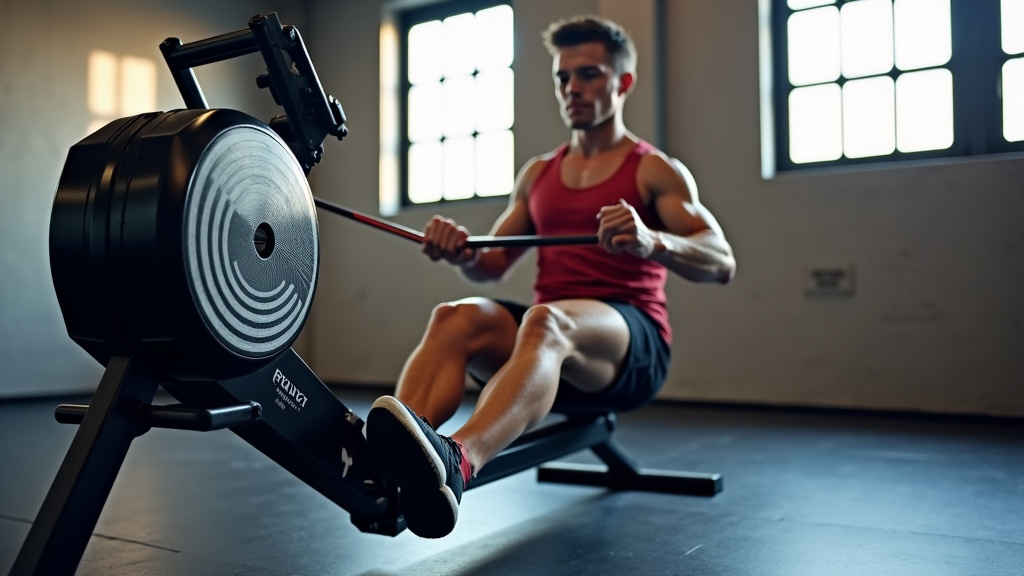
Rowing Machine vs. Other CrossFit Movements
It’s important to understand what rowing does and doesn’t replace in CrossFit training. It’s a powerful tool, but not a magic bullet for everything.
What Rowing Excels At
Rowing is king for cardiovascular conditioning and building muscular endurance across a large percentage of your body. It’s exceptional for improving your ability to sustain effort over time and recover quickly between bursts of activity. Think of it as building your engine.
What Rowing Doesn’t Directly Train
Rowing won’t directly improve your Olympic lifting technique (like snatch or clean and jerk) or your gymnastics skills (like handstand walks or muscle-ups). These require specific skill practice, strength, and mobility that are unique to those movements. You still need to practice these in your CrossFit class.
The Synergy: How They Work Together
The beauty is in how they combine. Better rowing endurance means you have more energy and focus for your lifting and skill work. A stronger core and back from rowing will help stabilize your lifts. This improved work capacity allows you to perform more reps, more sets, and handle heavier loads throughout a WOD. It’s a symbiotic relationship.
Sample Rowing Workout Integration Checklist
Here’s a quick checklist to help you integrate rowing into your week:
- Assess Your Current WODs: Note how often rowing appears.
- Schedule 2-3 Rowing Sessions: Mix them with your other CrossFit training.
- Focus on Technique: Watch videos and practice proper form.
- Try Different WOD Styles: Incorporate steady-state, intervals, and distance challenges.
- Use it for Warm-ups/Cool-downs: Get extra conditioning without taxing yourself.
- Listen to Your Body: Adjust intensity and duration based on how you feel.
By strategically adding rowing, you’re not just getting better at rowing; you’re becoming a more well-rounded, powerful, and resilient CrossFit athlete. You’re building that engine that allows you to tackle any challenge thrown your way.
Conclusion
You’ve learned that integrating a rowing machine into your CrossFit training is a smart move. It powerfully builds your cardiovascular endurance and muscular stamina, essential for high-intensity workouts. While it won’t replace skill-specific CrossFit movements, rowing enhances your overall work capacity and prepares you for rowing WODs. By focusing on proper technique and smart workout integration, you’ll become a more efficient and well-rounded athlete. Start adding 2-3 rowing sessions per week and feel the difference in your next WOD.
Frequently Asked Questions
Can rowing replace my CrossFit classes entirely?
No, rowing cannot entirely replace CrossFit classes. CrossFit involves a wide range of movements like weightlifting, gymnastics, and high-intensity interval training that rowing doesn’t directly train. Think of rowing as a powerful supplement to your CrossFit training, not a substitute.
How often should I row if I’m training for CrossFit?
Research suggests aiming for 2-3 rowing sessions per week. This frequency allows you to reap the cardiovascular and muscular endurance benefits without overtraining. You can use rowing for dedicated conditioning, warm-ups, or cool-downs.
What are the most common rowing mistakes CrossFitters make?
Many CrossFitters rush the recovery phase of the rowing stroke, which reduces efficiency and power. Over-pulling with the arms and not using the legs sufficiently for the drive are also common errors. Focusing on a smooth, powerful sequence from legs to core to arms is key.
Will rowing improve my Olympic lifts in CrossFit?
Rowing won’t directly improve your Olympic lifting technique, like the snatch or clean and jerk. However, it can indirectly help by improving your overall conditioning, core strength, and muscular endurance, which are foundational for heavier lifts.
How can I best prepare for a rowing-heavy WOD?
To prepare for a rowing-heavy WOD, incorporate interval training on the rower. This mimics the high-intensity bursts common in CrossFit. Practicing steady-state rows for longer durations will also build the endurance needed to maintain pace throughout a challenging workout.