How to Build CrossFit Rowing Workouts
CrossFit rowing workouts work best when you set a clear rowing distance or time, pair it with simple movements, and control the pace. Start with repeatable intervals, then add rounds, resistance, or movement complexity as your conditioning improves.
On this page (9 sections)
- What makes CrossFit rowing workouts effective?
- How should you structure a rowing and movement workout?
- Which rowing target should you use?
- How do you combine rowing with strength movements?
- What should beginners do first?
- Which equipment can support home CrossFit rowing workouts?
- How can you scale a hard workout?
- Can rowing replace all other CrossFit movements?
- What is the best way to progress?
CrossFit rowing workouts work best when you set a clear rowing distance or time, pair it with simple movements, and control the pace. A good session might use rowing intervals with squats, push-ups, lunges, burpees, or core work.
The rower can provide the conditioning focus while the other movements add strength, balance, or local muscle fatigue. The goal is not to sprint every interval.
It is to finish the planned work with repeatable technique.
What makes CrossFit rowing workouts effective?
A useful CrossFit rowing workout has a defined target, a manageable movement list, and a pace you can repeat. You can measure the rowing by time, distance, calories, or strokes, then place the movement work before, after, or between rowing efforts.
For example, a simple mixed workout could be:
- Row for 250 m.
- Complete 10 air squats.
- Complete 8 push-ups.
- Rest briefly.
- Repeat for 4 rounds.
This format is easy to scale because you can shorten the distance, lower the number of repetitions, or add more rest. It also makes your progress easier to compare from one session to the next.
Before building a harder plan, review how to build a rowing workout plan for help choosing session length, intensity, and recovery.
How should you structure a rowing and movement workout?
Use one of 3 simple structures: intervals, rounds for time, or an every-minute format. Each structure changes how you manage effort and rest.
Rowing intervals with fixed rest
Row for a set time or distance, then rest for a planned period. A beginner example is 6 rounds of 1 minute of rowing followed by 1 minute of rest.
Add 8 air squats after each rowing interval if you want a mixed workout. Keep the squats smooth instead of racing through them.
Rounds for time
Complete a fixed number of rounds as quickly as you can while keeping good form. Try 4 rounds of a 300 m row, 10 alternating reverse lunges, and 8 incline push-ups.
This format can become too hard if the first row is a sprint. Start at a pace that leaves enough control for the final round.
Every-minute training
Start a new task at the beginning of each minute. For example, row for 40 seconds in minute 1, complete 10 squats in minute 2, and rest during the remaining time in each minute.
This structure gives you built-in pacing. If you cannot finish the work with some time left, reduce the distance, duration, or repetitions.
Which rowing target should you use?
Choose time when you are new to rowing, distance when you want a clear benchmark, and calories only when your machine measures them consistently. A 30-second row is simple to scale, while a 250 m or 500 m row gives you a repeatable distance target.
Use moderate strokes for longer workouts. Harder rowing intervals can be short, but they need enough recovery to protect your form.
A practical progression is to keep the same movement circuit for 3 or 4 sessions. First improve your pacing, then add a round or slightly increase the rowing target.
Changing every variable at once makes it harder to know what helped.
How do you combine rowing with strength movements?
Pair rowing with movements that use a different emphasis, then keep the exercise list short. Rowing already involves the legs, hips, trunk, back, shoulders, and arms, so the best pairing depends on the workout goal.
For lower-body strength, use controlled squats or lunges after shorter rows. For upper-body work, use push-ups after rowing, but reduce the repetitions if your shoulders or grip are already tired.
For trunk training, add sit-ups or a plank hold. Keep the trunk position steady on the rower, because fatigue can make you round your back or pull mostly with your arms.
If you want a broader strength base for rowing, read how to build strength for rowing. The main idea is to support the rowing movement instead of turning every session into a test of exhaustion.
What should beginners do first?
Beginners should start with technique practice, short intervals, and movements they can repeat without losing control. Begin with 5 minutes of easy rowing, then complete 4 to 6 rounds of 30 seconds of rowing and 60 seconds of rest.
Add a small movement block only after the rowing feels steady. For example, complete 6 air squats after each row, or use a raised surface for push-ups.
Keep your sequence consistent. Push through the legs first, swing the body through a controlled position, then draw the handle toward the lower ribs.
Reverse the order on the recovery by extending the arms, swinging forward, and then bending the knees.
Stop or reduce the workload if you feel sharp pain, dizziness, unusual shortness of breath, or loss of control. Ongoing pain deserves medical advice before you continue hard training.
Which equipment can support home CrossFit rowing workouts?
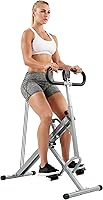
A rower with useful tracking can make timed intervals easier to follow. The Sunny Health & Fitness Smart Row-N-Ride Glute & Leg Trainer is a foldable squat assist rower with an exclusive SunnyFit app connection.
It uses adjustable resistance, 3 built-in resistance bands, multiple squat-angle positions, and an LCD monitor for time, count, total count, and calories.
Its adjustable handlebar and seat can help you set up the machine for your body. The frame is alloy steel, the machine weighs 24.5 lb, and its dimensions are 19.29 in deep, 50 in wide, and 45.27 in high.
The specs give a 220 lb maximum weight recommendation.
The Row-N-Ride suits a home athlete who wants rowing-related conditioning with a strong squat and lower-body emphasis. It is less suited to someone who wants a conventional long-rail rowing stroke for repeated distance benchmarks.
The Sunny Health & Fitness Compact Hydraulic Rower with 12-Level Resistance offers a more traditional rowing setup. It has 12 hydraulic resistance levels, an inclined rail, pivoting foot pedals, adjustable foot straps, a padded seat, an LCD meter, and a device holder.
It measures 58.1 in long, 20.1 in wide, and 24.8 in high, and weighs 22.4 lb. Its frame is alloy steel, and the specs give a 300 lb maximum weight recommendation.
The machine measures time, count, total count, calories, and scan.
Choose this rower if your CrossFit rowing workouts center on repeated rowing intervals and full-body strokes. Compare more options in Best Rowing Machine For CrossFit before deciding which setup fits your space and training style.
How can you scale a hard workout?
Scale one variable at a time: rowing distance, rowing time, repetitions, movement difficulty, or rest. This keeps the workout recognizable while making it safer to complete.
For example, change 500 m rows to 250 m rows before replacing air squats with jump squats. You can also use incline push-ups instead of floor push-ups, or step-ups instead of jumping movements.
If your pace drops sharply after the first round, the opening effort was too hard. Use the slowest round as a guide for your next session and aim to keep the difference between rounds small.
Can rowing replace all other CrossFit movements?
No. Rowing is useful conditioning, but it cannot replace every movement pattern.
It trains repeated leg drive and pulling, while a balanced program may also need pushing, loaded carries, single-leg work, overhead work, and controlled trunk exercises.
Rowing can support shoulder and back training, but it does not automatically build every upper-body quality. For a comparison of shoulder demands, see can swimming or row machine build shoulders.
Grip choice also changes how a pull feels. If you are considering arm-focused variations, read rowing machine build biceps assuming supinated grip and bicep curls on rowing machine before adding unusual movements to a rower.
What is the best way to progress?
Repeat the same workout until your pace and form are stable, then add a small amount of work. You might add 1 round, extend each row by 10 seconds, or reduce rest by a small amount.
Keep at least one easier rowing session in your weekly plan if you also perform hard strength or conditioning workouts. Your legs, back, shoulders, and grip all contribute to rowing, so total training load matters.
For most people, the best CrossFit rowing workouts are simple enough to repeat and flexible enough to scale. Choose the Row-N-Ride for compact squat-focused conditioning, or choose the Compact Hydraulic Rower for conventional rowing intervals with 12 resistance levels and a longer rail.
Frequently asked questions
How long should a CrossFit rowing workout be?
A CrossFit rowing workout can take 10 to 25 minutes, depending on the interval structure and movements. Beginners can start with short rounds and longer rest, while experienced athletes may use repeated 500 m rows, timed calories, or longer mixed circuits.
Keep the pace controlled enough to maintain sound form.
What movements pair well with rowing?
Squats, push-ups, lunges, burpees, kettlebell movements, and sit-ups pair well with rowing because they add lower-body, upper-body, or trunk work without changing the workout structure too much. Choose movements you can repeat with safe technique after your heart rate rises.
Is rowing good for CrossFit conditioning?
Yes, rowing supports CrossFit conditioning because it combines leg drive, trunk control, and an upper-body pull in a repeatable movement. It works well for intervals, longer aerobic pieces, and mixed workouts.
Your result still depends on pacing, technique, recovery, and the other movements you include.
How often should you do CrossFit rowing workouts?
Start with 1 or 2 CrossFit rowing workouts per week, especially if rowing is new to you. Leave recovery time between hard sessions and vary the format so every workout is not an all-out effort.
Reduce the workload if your back, knees, shoulders, or grip remain sore.