How to Do Standing Dumbbell Rows
To do standing dumbbell rows, hinge at your hips, keep your back flat, pull the dumbbells toward your ribs, and lower them slowly. Use a weight you can control without twisting or shrugging.
On this page (9 sections)
- How do you do standing dumbbell rows?
- What position should you use for a standing dumbbell row?
- Where should your elbows go during standing dumbbell rows?
- How do you control the lifting and lowering phases?
- What are the most common standing dumbbell row mistakes?
- How many sets and repetitions should you do?
- How can you organize dumbbells for standing rows?
- What other standing dumbbell exercises pair with rows?
- How do you know your standing dumbbell row form is ready?
To do standing dumbbell rows, stand with your feet about hip-width apart, hinge forward with a neutral back, pull the dumbbells toward your lower ribs, and lower them under control. Keep your shoulders level and avoid using momentum to lift the weights.
The standing dumbbell row is a useful back exercise because it combines an upper-body pull with a stable hip-hinge position. Your legs and trunk support the position, while your upper back and arms move the dumbbells.
How do you do standing dumbbell rows?
The basic standing dumbbell row has 6 steps: set your feet, brace, hinge, pull, pause, and lower.
- Stand with a dumbbell in each hand and your arms hanging by your sides.
- Place your feet about hip-width apart and soften your knees.
- Push your hips back until your torso leans forward while your back stays neutral.
- Brace your stomach and let the dumbbells hang below your shoulders.
- Pull your elbows back toward your ribs without shrugging.
- Pause briefly, then lower the dumbbells slowly to the starting position.
Keep the dumbbells close to your legs as they move. Your torso should stay still while your arms and shoulder blades control the row.
For another standing dumbbell movement, compare best standing dumbbell exercises. A mix of rows, presses, curls, and other movements can help you build a simple workout without needing a large setup.
What position should you use for a standing dumbbell row?
Use a hip hinge with a neutral spine, slightly bent knees, and relaxed shoulders. The hinge places your torso at an angle so your upper back has to pull the dumbbells upward.
Think about sending your hips behind you rather than squatting straight down. Keep your head aligned with your spine, and look at the floor several feet in front of you instead of lifting your chin.
Your arms should hang beneath your shoulders at the start of each repetition. If the dumbbells touch the floor, reduce the hinge or use a lighter range of motion that lets you keep your back position.
A weight bench can change the exercise by giving you support for one hand or knee. If you're building a home setup, our guide to which weight bench to buy can help you compare bench types and space needs.
How does the standing dumbbell row differ from a supported row?
A standing dumbbell row uses your trunk and hips to hold the hinged position. A supported row places one hand or both hands on a bench, which can reduce the balance demand and let you focus more closely on the pulling motion.
Neither option is automatically better. Choose the standing version when you want to train the hinge and row together, and choose support when maintaining the torso position is difficult.
Where should your elbows go during standing dumbbell rows?
Pull your elbows back and slightly out from your body, with the dumbbells traveling toward your lower ribs or waist. The best path is the one that lets you move smoothly without shrugging or twisting.
Avoid forcing your elbows high behind you. A very high elbow path can make the movement feel more like a shoulder exercise and may encourage you to lift with momentum.
Keep both sides moving at a similar speed. If one dumbbell rises much faster, lower the weight or shorten the set until you can control both sides.
The shoulder position matters more than touching the dumbbells to your body. Stop the pull when your elbows reach a comfortable point behind your torso, then lower with control.
How do you control the lifting and lowering phases?
Use a smooth pull and make the lowering phase deliberate. The dumbbells should not swing away from your legs or drop quickly from the top.
Breathe out as you pull and breathe in as you lower, or use a steady breathing pattern that helps you brace. Do not hold your breath for a long set, especially if you feel lightheaded.
Start with a small number of controlled repetitions. Add repetitions or weight gradually, but change only one part of the workout at a time so you can tell whether your form remains steady.
The PowerBlock Elite EXP 90 Adjustable Dumbbells suit home lifters who want a pair with 16 weight increments from 5 lb to 50 lb per hand, including 2.5 lb micro weights, in a compact 12 in L x 7 in W x 7 in H design. For heavier adjustable options, see heavy adjustable dumbbells.
Keep the selected weight the same on both dumbbells for a balanced standing row. The set includes 2 adjustable dumbbells, and its Elite EXP 90 expansion kits can increase the load to 70 lb or 90 lb per hand, sold separately.
What are the most common standing dumbbell row mistakes?
The most common mistakes are rounding the back, jerking the weights, shrugging, and turning the row into a standing curl.
A rounded back usually means the hinge is too deep for your current mobility or the dumbbells are too heavy. Raise your torso slightly and reduce the load until you can keep your spine neutral.
Jerking often happens when the weight is beyond your control. Pause at the top only if you can keep your shoulders level, then lower without dropping the dumbbells.
Shrugging moves the shoulders toward the ears instead of keeping the upper back involved. Keep your neck relaxed and think about pulling your elbows back.
Do not bend your elbows early and curl the dumbbells toward your shoulders. The elbows should travel back as the main action, with the hands following them.
How many sets and repetitions should you do?
Start with 2 or 3 sets of 8–12 controlled repetitions, using a weight that leaves you able to keep the same position from the first repetition to the last. Rest long enough to regain control before the next set.
For strength practice, use fewer repetitions with a heavier load only after your technique is consistent. For general fitness, moderate repetitions and a smooth pace are usually easier to manage.
Your row count should fit the rest of your workout. If you also use a rowing machine, compare how long should I row on a rowing machine? and how many rows should I do on a rowing machine? because machine rowing and dumbbell rows are different exercises.
How can you organize dumbbells for standing rows?
Store dumbbells where you can pick them up and return them without bending, twisting, or stepping over other equipment. A clear floor also gives you room to set your feet and hinge safely.
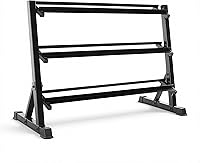
The CAP 2-Tier & 3-Tier Dumbbell Rack for Home Gym is a heavy-duty steel rack with 3 shelves, 51.57 in length, 25.6 in width, 37.4 in height, and a 1,000 lb weight capacity.
Place the rack on a flat, level surface before tightening its hardware. Its stated style is 3-tier for 5–50 lb, so measure your room and check the dumbbell sizes you plan to store before arranging the rack.
For lighter training, the JFIT Dumbbell Pairs or Sets include pairs of 3 lb, 5 lb, and 8 lb neoprene dumbbells with a stand rack. The hex-shaped ends help prevent rolling between sets.
The neoprene coating provides a soft, non-slip grip, while the cast-iron core keeps the dumbbells solid through repeated use. Use the lighter pairs to practice your hinge and pulling path before moving to heavier weights.
For an example of this load, see 10 lb dumbbells.
What other standing dumbbell exercises pair with rows?
Pair standing rows with movements that train a different direction, such as a standing shoulder press, curl, or chest-focused exercise. Keep the load light enough that fatigue does not change your row position.
For overhead work, see how to do dumbbell standing shoulder press. For arm work, read what is a standing dumbbell curl, and for chest movement, see what is a standing dumbbell fly.
A standing dumbbell chest press is not the same as a row because the pressing path moves the weights away from your body. Review what is a standing dumbbell chest press before adding it to the same session.
How do you know your standing dumbbell row form is ready?
Your form is ready to progress when you can hinge without rounding, pull without twisting, and lower both dumbbells at the same speed. Add weight only when those points stay consistent for every repetition.
Stop the set if you feel sharp pain, numbness, or a sudden loss of control. For ongoing pain or uncertainty about exercise safety, ask a qualified health professional for advice.
The key rule for how to do standing dumbbell rows is simple: choose a controllable weight, keep your torso stable, pull toward your ribs, and lower slowly. Pick adjustable PowerBlock dumbbells if you want gradual load changes, JFIT if you need lighter pairs, or the CAP rack if organized storage is the main problem.
Frequently asked questions
What muscles do standing dumbbell rows work?
Standing dumbbell rows mainly train the upper back, including the muscles around the shoulder blades, while your arms assist the pull. Your hips, trunk, and legs also work to hold the hinged position.
The exact emphasis changes with your elbow path, grip, range of motion, and weight.
Should your back be straight during a standing dumbbell row?
Keep your spine in a neutral position while your torso leans forward from the hips. Do not round your upper or lower back to reach farther.
A neutral back does not mean your torso must be upright, because the row starts from a controlled hip hinge.
How heavy should dumbbells be for standing rows?
Choose dumbbells that let you complete every repetition with a steady torso, smooth pull, and controlled lowering phase. If you twist, shrug, jerk, or lose your back position, reduce the weight.
Add load only when your current sets stay controlled.
Can beginners do standing dumbbell rows?
Yes, beginners can start with light dumbbells and a short set while learning the hip hinge and shoulder movement. Practice the position without weights first, then use a load that leaves room for control.
Stop if you feel sharp pain, numbness, or unusual joint discomfort.