How to Do a Standing Dumbbell Shoulder Press?
Stand tall, brace your core, press both dumbbells straight overhead, and lower them with control. Keep your wrists stacked over your elbows and stop before your lower back arches.
On this page (12 sections)
- How to Do a Standing Dumbbell Shoulder Press
- What is a standing dumbbell overhead press?
- How do you set up for a standing dumbbell shoulder press?
- How do you perform the press?
- How do you breathe during a standing dumbbell press?
- What weight should you use for a standing dumbbell shoulder press?
- What mistakes make the standing press less effective?
- How can you keep dumbbells organized between sets?
- Are fixed dumbbell sets useful for learning the movement?
- How can you progress without losing form?
- What exercises should you avoid pairing carelessly?
- What is the simplest way to learn the standing dumbbell press?
How to Do a Standing Dumbbell Shoulder Press
To do a dumbbell standing shoulder press, stand with your feet about hip-width apart, hold the dumbbells beside your shoulders, brace your midsection, and press both weights overhead without leaning back. Lower them slowly to the starting position and repeat for controlled reps.
This movement is also called a dumbbell standing overhead press or standing dumbbell overhead press. The main goal is consistent dumbbell movement, with both weights traveling in a similar path while your torso stays still.
What is a standing dumbbell overhead press?
A standing dumbbell overhead press is a shoulder exercise where you press two dumbbells from shoulder height to above your head. Your shoulders and triceps drive the press, while your core helps keep your ribs, pelvis, and spine aligned.
Unlike a seated press, the standing version asks your legs and trunk to stabilize your body. That doesn't mean you should bounce or push with your legs.
Keep the movement strict unless you're following a separate exercise variation.
If you want to compare this movement with another standing dumbbell press, read what is a standing dumbbell chest press. A chest press uses a different arm path and trains a different pressing pattern.
How do you set up for a standing dumbbell shoulder press?
Start with your feet stable, your dumbbells at shoulder height, and your wrists stacked over your forearms. Your elbows should sit slightly in front of your body instead of flaring directly out to the sides.
- Stand with your feet about hip-width apart.
- Hold one dumbbell in each hand.
- Bring the dumbbells beside your shoulders.
- Keep your palms facing forward or slightly inward.
- Brace your abdomen as if preparing for a light punch.
- Keep your chin level and your gaze forward.
Use a stance that lets you balance without shifting from one foot to the other. If you need to step around equipment between sets, a clear storage plan helps, so compare which weight bench to buy if you're building a broader dumbbell area.
How should your wrists and elbows line up?
Keep each wrist above or slightly behind its elbow at the start. This gives the dumbbell a stable base and reduces the urge to bend your wrists backward.
Your forearms should be close to vertical when viewed from the front. If your elbows flare wide, lower the weights and reset before beginning the next rep.
How do you perform the press?
Press the dumbbells upward in a smooth path, then lower them slowly until they return beside your shoulders. Keep the weights moving together without letting one side rush ahead.
Drive the dumbbells up as your arms straighten. As they pass your head, allow them to move slightly inward if that feels natural, but don't force the weights together at the top.
At the top, keep your ribs down and your shoulders away from your ears. You can finish with your elbows straight or nearly straight, then pause briefly before lowering.
Lower both dumbbells under control. The lowering phase should not become a drop, because the return to shoulder height is part of the exercise.
How do you breathe during a standing dumbbell press?
Breathe in before the press, brace your trunk, and breathe out as you move through the hardest part. Take another controlled breath after the dumbbells return to shoulder height.
Avoid holding your breath for a long sequence of reps. Keep the brace firm enough to prevent your back from arching while still allowing a controlled breathing rhythm.
If your breathing becomes rushed, shorten the set or reduce the dumbbell weight. A slower set with matching movement is more useful than extra reps with a loose torso.
What weight should you use for a standing dumbbell shoulder press?
Use the heaviest pair you can press without back arching, shrugging, twisting, or losing control on the way down. The right starting weight is different for every person, so form should decide the load.
Adjustable dumbbells suit people who want small weight changes as their strength develops.
The PowerBlock Elite EXP 90 set includes 2 dumbbells and measures 12 in L x 7 in W x 7 in H. It is designed to replace 16 traditional dumbbell pairs, which can help in a small workout space.
The set uses a magnetic polypropylene pin for adjustment, with weight markings to make changes easier between sets. Its Stage 1 range reaches 50 lb per hand, while separate Stage 2 and Stage 3 expansion kits can increase the range to 70 lb or 90 lb per hand.
Those expansion kits are sold separately and are not compatible with Elite USA 90 expansions or accessories.
Choose this set if you want one adjustable pair for pressing, rows, curls, and other full-body exercises. Choose fixed weights instead if you prefer to change equipment instantly without adjusting between sets.
What mistakes make the standing press less effective?
The most common mistakes are leaning back, flaring the elbows, using momentum, and lowering too quickly. Each one makes it harder to keep the dumbbells on a steady path.
A backward lean often means the weight is too heavy or the core is no longer braced. Lower the weight, bring your ribs down, and stop the set if you cannot keep your torso steady.
Don't turn the press into a leg drive by bending and snapping your knees. If you want a push press, treat it as a separate variation with its own technique.
Shrugging toward your ears can make the movement feel crowded. Keep your neck relaxed and let your shoulders move naturally without forcing them down.
For another upper-body dumbbell pattern, see how to do standing dumbbell rows. Rows use a pulling motion, so they can balance a routine that includes several pressing exercises.
How can you keep dumbbells organized between sets?
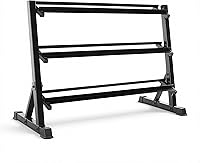
Store dumbbells where you can lift them without bending, twisting, or stepping over other weights. A stable rack can also keep the training area clear for standing exercises.
For compact dumbbell storage, compare small dumbbell racks for home.
The CAP rack is made from steel and has 3 shelves, with 51.57 in of length, 25.6 in of width, and 37.4 in of height. It has angled lower shelves and a stated maximum weight capacity of 1,000 lb.
This rack is suited to a home gym with several pairs of hex dumbbells. Place it on a flat, level surface, and don't fully tighten the bolts until assembly is complete.
Choose it if your main problem is scattered fixed weights. Skip it if you only have one adjustable pair and don't need a larger storage frame.
Are fixed dumbbell sets useful for learning the movement?
Fixed pairs can be useful when you want simple, repeatable practice with lighter loads. They let you focus on posture, arm paths, and breathing without adjusting the weight during a session.
The JFIT set includes pairs of 3 lb, 5 lb, and 8 lb dumbbells plus a stand rack. The dumbbells have neoprene coating, hex-shaped ends, and a cast-iron core.
The hex ends help prevent rolling between sets, while the neoprene coating provides a non-slip grip and helps protect hands and floors. The set contains 7 pieces in total, including the stand rack.
Choose it if you need lighter fixed pairs for beginners, warm-ups, or higher-rep shoulder work. For a light fixed-weight option, compare 10 lb dumbbells.
It may not suit you if you need more than 8 lb per hand for your main pressing sets.
How can you progress without losing form?
Progress by adding controlled reps first, then a small amount of weight when every rep stays steady. Keep the same stance, range, and lowering speed as you increase the challenge.
Start with a manageable set size, such as 6–10 reps, and stop before your torso starts leaning. Rest long enough to repeat the movement without rushing.
You can also use a single-arm press, but keep the non-working side still and avoid bending toward the loaded side. Include other standing dumbbell movements from how to work out with dumbbells while standing if you want a broader routine.
Don't increase weight just because the first few reps feel easy. The last controlled rep should look like the first, with no twisting or shortened range.
What exercises should you avoid pairing carelessly?
Pair the shoulder press with movements that leave enough control for your next set. Heavy pressing followed immediately by another demanding shoulder exercise can make your technique break down.
A wide-grip upright row uses a different pulling pattern, so read about upright row wide grip before adding it to the same workout. If your shoulders feel irritated, reduce the total overhead and pulling volume rather than forcing more exercises.
Rowing machines also involve the upper body, but they don't replace a controlled dumbbell press. See does rowing machine work shoulders and is rowing machine good for shoulders for how rowing fits into shoulder-focused training.
A standing curl is another simple dumbbell option, but it trains elbow flexion rather than overhead pressing. Learn what is a standing dumbbell curl before building a full standing routine.
What is the simplest way to learn the standing dumbbell press?
Begin with light dumbbells, a stable stance, and slow repetitions that keep both arms moving together. Increase the load only when you can press without leaning, shrugging, twisting, or dropping the weights.
Choose the PowerBlock pair if gradual weight changes and compact storage matter most. Choose the JFIT set if lighter fixed pairs and a small rack fit your training space, or choose the CAP rack if you already have several dumbbell pairs to organize.
The key rule for how to do a dumbbell standing shoulder press is simple: keep the torso quiet, press smoothly, and lower under control. Stop for sharp pain, and seek professional advice for ongoing shoulder, neck, or back symptoms.
Frequently asked questions
What muscles does a standing dumbbell shoulder press work?
A standing dumbbell shoulder press mainly trains the shoulder muscles while your triceps help straighten the elbows. Your core and legs also work to keep your body steady, especially when you press both dumbbells from a standing position without leaning or using momentum.
Should dumbbells touch at the top of a shoulder press?
No. Dumbbells don't need to touch at the top.
Press them until your elbows are straight or nearly straight while keeping your ribs down and your shoulders controlled.
Stopping with a small gap between the weights can help you avoid forcing your shoulders into an uncomfortable position.
How heavy should dumbbells be for a standing shoulder press?
Choose a weight that lets you complete every rep with a steady torso, neutral wrists, and a controlled lowering phase. If you arch your back, shrug hard, or swing the weights, reduce the load.
Start lighter than you expect because standing presses demand balance as well as shoulder strength.
Is a standing dumbbell shoulder press safe for everyone?
It can be a useful strength exercise, but it isn't right for every shoulder, neck, or back problem. Use a pain-free range, stop if you feel sharp or worsening pain, and ask a qualified health professional for guidance if symptoms persist or you have an injury.